Project Phases
Phase 1 — Inception and Research Design (Weeks 1–3): Kickoff, workplan alignment, decision gate review, regional candidate list construction, screening criteria finalisation, ALJ design for primary research phase, stakeholder recruitment plan, interview guide development, bias control protocols.
Phase 2 — Regional Screening and Desk Research (Weeks 4–6): Application of the Regional Adoption Readiness Framework to all candidate regional clusters. Initial scores based on publicly available evidence. Production of the preliminary market prioritisation matrix. Identification of priority clusters for deep-dive primary research.
Phase 3 — Primary Research and Field Access (Weeks 7–12): Stakeholder interviews, expert calls, ALJ facilitation in selected hub locations, local partner engagement, regulatory mapping, infrastructure assessment, and counterparty mapping. Minimum of 30–45 primary research interactions across respondent types.
Phase 4.1 — Analysis and Framework Development (Weeks 13–15): Cross-evidence synthesis, RARF score refinement, CASS classification of identified signals, playbook drafting, regulatory summary drafting, counterparty access register compilation.
Phase 4.2 — Drafting and Review (Weeks 15–17): Full draft of all core deliverables, CPC review, validation against decision gates, revision of findings where access or evidence constraints require recalibration.
Phase 5 — Final Delivery (Week 18): Final report, executive decision memo, public summary, cross-RFP handoff memo, presentation to CPC.
Reading Guidance
This page is intended to help the reader internalise the overall flow of the whole project. That’s a crucial step for every participating actor, in order to be able to sense into where we are as one coordinated whole at any point in time.
This is a communication hack. Here are two types of communication:
- People try to understand complex systems by breaking them into separate parts, and then they try to speak about those parts to others with functional language.
- People describe a complex system with metaphors, in a way that engages the intuition.
What can happen with (1) is that vast amounts of time are spent trying to analytically join everything back together. It engages the mind, and people try to calculate what the current state of the system is by asking for discrete information, which can often generate a feeling of standing under a never-ending waterfall of increasing uncertainty.
When can happen with (2) is that people speak from the same innate understanding, and can explore the complexity together in dialogue, building up common understanding, without the arresting1 nature (tensions rising) of the analytical mind.
In summary, option (2) is way cooler.
So we’re going to do that now, and throughout this project whenever we need to regroup and work out where in the process we are.
Full disclosure: credit to Delfina Terrado for this wisdom.
Engaging Intuition
A metaphor is shared below, but each reader is welcome to interpret the project phases in their own way to create their own.
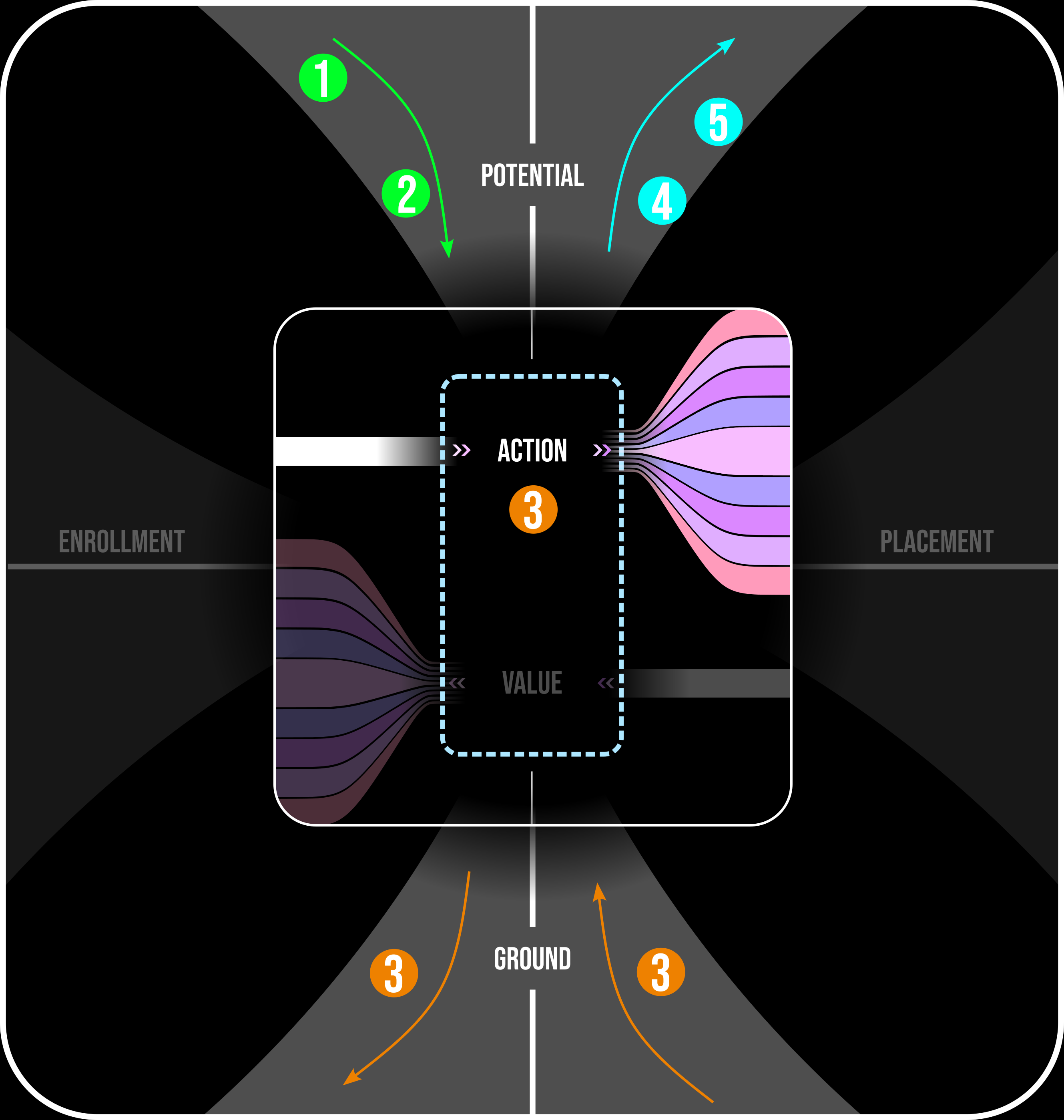
The metaphor, coincidentally, draws on the organising pattern prisma uses for events. After all, this is a pattern of multi-stakeholder convergence, generating data from field excursions to make visible regional hotspots of potential.
The diagram below maps the 5 project phases onto this organising pattern, but a text description of that same flow would be as follows.
There’s three movements: arrival, action and return. Alternatively, preparation, action and reward. Or, perhaps, preparation, generation and collection. In any case, the metaphor offered for how to interpret the project phases is one of a kind of spiraling towards something, then lots of activity, then an outward spiraling from that core.
Footnotes
-
Báyò Akómoláfé ↩